Every parent loves that moment when their child wins a tough tackle, clears a dangerous ball, or rallies teammates with a confident shout. Those moments often come from one of the most underrated yet essential roles on the field: the stopper position in soccer, which players know as the backbone of any strong defense.
If your child is curious about defending — or if a coach has already pointed them toward the back line — understanding this role can help you support their growth at home and on the pitch. A great stopper isn’t just a player who tackles hard; they’re a thinker, a leader, and the calm voice in the middle of every defensive storm.
This complete guide breaks down what a stopper does, how the position differs from other defenders, the skills young players must develop, and why this role builds confidence, leadership, and resilience in young athletes. We’ll also show you how the FC Bayern Academy approach develops complete defenders from the ground up — and why summer training can be a turning point in your child’s soccer journey.
What Is the Stopper Position in Soccer?
The stopper position in soccer that coaches refer to is the more aggressive of the two central defenders in a traditional back line. In classic formations, the stopper plays slightly higher than the sweeper, stepping forward to break up attacks before they reach the goal.
Think of the stopper as the first line of defensive resistance in the central area of the field. Their job is to challenge strikers, win duels, disrupt the opponent’s rhythm, and set the tempo for the entire defense. According to coaching resources from U.S. Soccer, strong youth soccer defender positions are built on reading the game early — not just reacting late.
The Evolution of the Stopper Role
While the term “stopper” comes from older defensive systems with a clear sweeper-stopper pairing, modern soccer has evolved. Today’s central defender role often blends both jobs into one. However, many youth coaches in the U.S. still teach the traditional stopper-sweeper structure because it helps kids learn defensive principles in a clear, easy-to-understand way.
For young players, learning this role teaches a powerful mix of courage and discipline. It’s not just about being tall or strong — it’s about timing, vision, communication, and trust. The best stoppers in the world, from past Bayern Munich legends to today’s stars, all share the same foundational habits that can be developed from a young age.
Key Responsibilities of a Stopper on the Field
The defensive stopper in soccer carries a clear list of responsibilities that shape every match. While the role looks simple from the stands, it requires constant focus, awareness, and split-second decision-making.
Here are the core stopper responsibilities on the field:
- Winning aerial duels on long balls, crosses, and goal kicks
- Tackling cleanly against forwards in 1v1 situations
- Intercepting passes before they reach the striker
- Communicating constantly with the goalkeeper and fullbacks
- Clearing danger quickly and accurately under pressure
- Marking the opposing center forward during set pieces
- Starting attacks with smart, composed passes out of the back
- Tracking late runners from midfield into the box
- Adjusting the defensive line to keep attackers offside when appropriate
- Pressing forward to support midfielders during attacking phases
A great stopper doesn’t just defend — they set the tone for the entire team. When the stopper is calm and decisive, the whole back line plays with more confidence. When they’re nervous or hesitant, the cracks show quickly.
The Stopper’s Role in Building from the Back
The stopper position in soccer has become more demanding over time. Today’s top defenders need excellent passing range, the ability to play under pressure, and the vision to launch attacks with one accurate ball. This is especially true in soccer back-four formations, where the center-backs are often the first to receive the ball from the goalkeeper.
Coaches at the youth level now train defenders not only to stop attacks but also to start them. This dual responsibility makes the position one of the most challenging — and rewarding — on the field.
Stopper vs. Sweeper — Understanding the Difference
One of the most common questions parents ask is about stopper vs sweeper roles. Both are central defenders, but they have very different jobs on the field. Modern soccer back-four formations sometimes blend these roles, but the traditional contrast still helps young players understand defensive structure.
Here’s a simple comparison:
| Feature | Stopper | Sweeper |
|---|---|---|
| Position on field | Slightly higher, closer to midfield | Deeper, closer to the goalkeeper |
| Primary role | Attack the ball and the striker | Cover space behind the stopper |
| Style of play | Aggressive, physical, proactive | Calm, reading the game, reactive |
| Key skill | Tackling and heading | Positioning and anticipation |
| Main duty | Stop attacks before they develop | Clean up anything that gets through |
| Personality fit | Bold, vocal, competitive | Patient, analytical, composed |
| Passing role | Short, sharp distribution | Long, switching passes |
Why This Distinction Still Matters for Young Players
Understanding this difference helps young players know when to step up and when to drop back — a tactical decision that defines elite defenders. Even if your child eventually plays in a flat back four, learning the stopper-sweeper relationship gives them a much deeper understanding of defensive movement and space.
At the youth level, many coaches rotate players between these two roles so they can experience both perspectives. This builds complete defenders who can adapt to any system as they grow.
Skills Every Young Stopper Needs to Develop
Becoming a great defender takes time, repetition, and the right coaching. The stopper position in soccer demands a balance of physical, technical, and mental skills that work together.
Physical Traits
- Strength and balance for shielding and tackling
- Speed over short distances to recover quickly
- Jumping ability for winning headers
- Endurance to stay sharp for a full match
- Body coordination for changing direction at speed
- Core stability for holding off bigger strikers
Technical Skills
- Clean tackling technique (front-foot, block, and slide tackles)
- Heading accuracy on both defense and offense
- Short and long passing to start attacks
- First touch under pressure when receiving back-passes
- Shielding the ball from pressing forwards
- Defensive footwork to stay between the attacker and the goal
- Set-piece marking with awareness of runners and blockers
Mental Traits
- Reading the game several seconds ahead
- Decision-making under fast-paced pressure
- Leadership and voice to organize teammates
- Composure when the game gets tough
- Concentration during long stretches without ball action
- Emotional control after mistakes or tough referee calls
The FIFA Training Centre offers excellent insights into how modern youth defensive tactics are taught at the highest levels — and the principles apply just as well to grassroots and academy programs across the United States.
Drills That Help Young Stoppers Improve
Parents often ask which exercises help kids develop in this position. Some of the most effective youth drills include:
- 1v1 defending in a channel — teaches angle, body shape, and patience
- 2v2 small-sided games — develops communication and covering
- Aerial duel exercises — sharpens timing and bravery in the air
- Pass-and-press patterns — builds passing under pressure
- Tracking-runner games — improves awareness of late attackers
These drills can be practiced in any quality summer camp or weekly training environment — and they form the foundation of how professional academies teach defending.
Why the Stopper Role Builds Character in Youth Players
Beyond the tactical benefits, the center-back stopper role shapes who your child becomes off the field too. Defenders learn lessons that translate directly into school, friendships, and family life.
Playing this role helps young athletes develop:
- Accountability — every mistake is visible, and every recovery matters
- Leadership — they must organize teammates and speak up constantly
- Resilience — they bounce back from tough moments fast
- Discipline — they hold their position even when the action moves away
- Team-first thinking — they sacrifice glory for the good of the group
- Patience — they learn that the right moment is more important than the fastest moment
- Humility — they understand that good defending is often invisible to the crowd
Organizations like Positive Coaching Alliance have shown that team sports — especially leadership positions like defender — help kids build emotional resilience and self-confidence that last well beyond their playing years.
Real Life Lessons from the Back Line
A stopper who lets one ball slip past must keep going. They can’t sulk. They can’t disappear. They have to organize, recover, and lead the next play — sometimes within seconds. That kind of mental toughness is exactly what helps young people thrive in school presentations, difficult friendships, or family challenges.
For many young players, stepping into the stopper role is the moment they go from being a participant to being a true competitor — and often, a real leader.
Common Mistakes Young Stoppers Make (and How to Fix Them)
Even talented young defenders make predictable mistakes early in their development. Parents and coaches who recognize these patterns can help kids grow faster.
Here are the most common issues:
- Diving in too quickly — young players often go to ground when they should stay on their feet
- Ball-watching — losing track of the striker behind them while watching the play
- Poor communication — staying silent instead of guiding teammates
- Hesitating on clearances — trying to play fancy passes in dangerous areas
- Losing focus when the ball is far away — switching off during quieter moments
The good news? Every one of these habits can be corrected with patient coaching, repetition, and the right environment. That’s exactly what high-level academies focus on during summer training programs.
How FC Bayern Academy Trains Future Stoppers
The FC Bayern Academy approach to defending blends German tactical heritage with modern, player-centered coaching. Our methodology is built on three pillars: technical mastery, tactical intelligence, and personal growth.
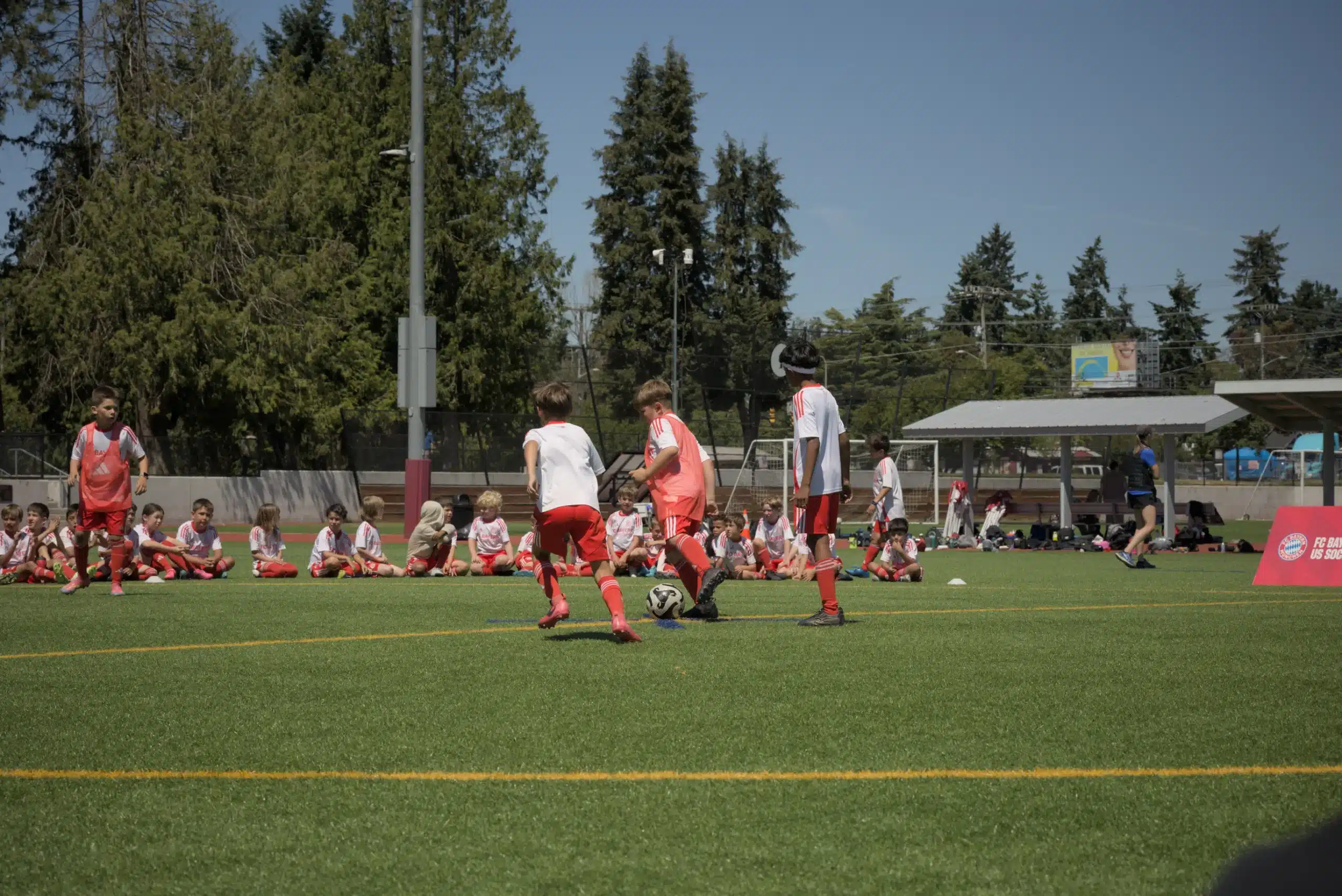
At the FC Bayern Academy summer camp, defenders work on:
- 1v1 defending drills that build courage and timing
- Small-sided games that sharpen decision-making
- Positional sessions that teach when to step, drop, or cover
- Communication exercises that develop leadership voice
- Set-piece training for both defense and attack
- Building from the back under realistic pressure
- Video and tactical reviews appropriate for each age group
- Mental performance moments that build confidence and focus
The Bayern Philosophy: “Mia san mia”
The famous Bayern Munich motto — “Mia san mia” (We are who we are) — runs through every session. It means playing with pride, courage, and identity. For young defenders, this translates into owning their role, defending with bravery, and leading with example rather than ego.
UEFA-Licensed Coaches and Proven Methodology
Our UEFA-licensed coaches follow the same developmental principles that have shaped generations of world-class Bayern Munich defenders. Coaches certified by United Soccer Coaches also recognize this style of holistic training as a gold standard for youth development in the United States.
Every training plan is age-appropriate and adjusted for skill level. A seven-year-old discovering soccer for the first time gets a very different session than a fifteen-year-old preparing for high school tryouts — but both receive the same level of attention, expertise, and care.
Fun First, Always
We also keep training fun, engaging, and full of energy — because no child grows in a stressful environment. Through our FC Bayern Youth programs, kids fall in love with defending while learning the same concepts the pros use. They laugh, they compete, they make friends, and they leave each session a little more confident than when they arrived.
What Parents Can Do at Home to Support Young Defenders
You don’t need to be a soccer expert to help your child develop. Some of the most powerful support happens off the field. Here are simple ways parents can encourage a young stopper:
- Watch professional matches together and point out great defenders
- Praise effort and bravery, not just clean tackles or wins
- Avoid coaching from the sidelines — let coaches coach
- Ask reflective questions after games (“What did you notice today?”)
- Encourage rest and recovery — sleep and nutrition matter more than extra drills
- Celebrate the small wins like good communication or a smart positional choice
These habits create the kind of safe, supportive environment that helps kids fall in love with the game and stay in it for life.
Your Player’s Next Step
The stopper position in soccer offers more than tactical learning — it shapes confident, resilient, team-first athletes who lead by example. Great defenders aren’t born; they’re built through expert coaching, smart repetition, and an environment that values every player’s development.
Whether your child is just discovering the back line or already loves defending, the right summer can change everything. World-class instruction, European methodology, and unforgettable friendships are exactly what FC Bayern Academy delivers each summer in the United States.
Give your child the chance to train like the pros, grow as a leader, build new friendships, and have the best summer of their life — all while wearing the colors of one of the most successful clubs in the world.
Limited Spots — Summer Dates Are Filling Fast
Help your young defender unlock their full potential with world-class FC Bayern coaching, fun-filled training sessions, lifelong friendships, and unforgettable memories on the field.