In every great soccer match, there is usually one player who seems to appear at exactly the right moment. While midfielders control the rhythm and defenders protect the back line, this player is often the one expected to turn chances into goals. Their movement, timing, and finishing can completely change the outcome of a game. But what exactly makes this role so important, and what does it involve? That leads to a common question: what is a striker in soccer?
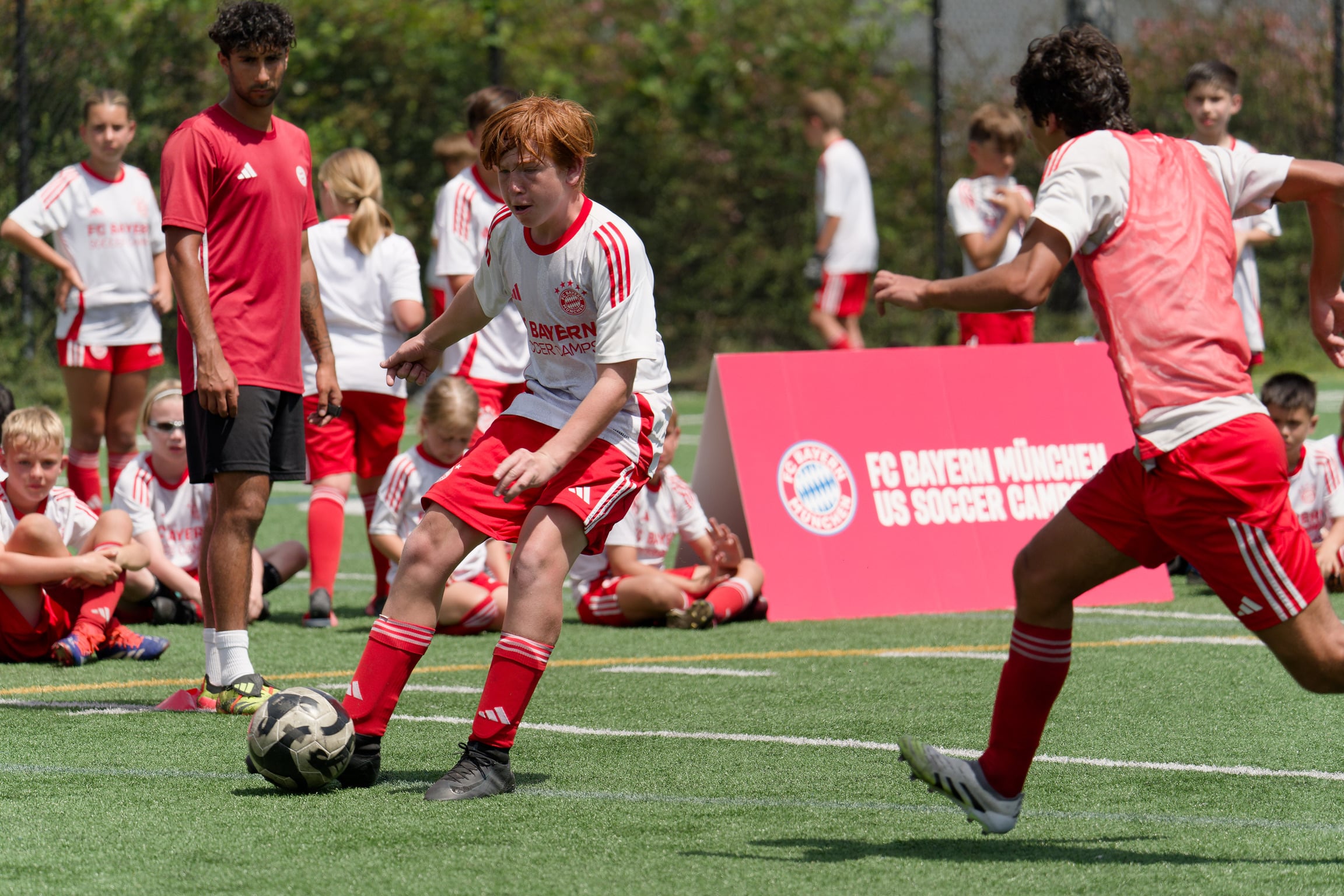
At FC Bayern Academy, we help young players understand the game beyond technique alone, developing their tactical awareness, decision-making, and confidence in every position on the field. Let’s see what makes a great striker in soccer and how to become one.
Understanding the role and responsibilities of a striker
What exactly is the striker’s role and what responsibilities do they carry on their shoulders? Let’s take a closer look.
In a nutshell, a striker’s primary job is to score goals – sounds simple. But there’s so much more to it. The striker is the offensive powerhouse of the team, positioned upfront to capitalize on goal-scoring opportunities and bring glory to the team. While the ultimate objective is indeed to send the ball into the back of the net, the way a striker goes about this task is multifaceted and nuanced.
One key aspect of a striker’s role is to create space. This means maneuvering in a way that distorts the opponent’s defensive formation, allowing the striker or their teammates to exploit the gaps. Also, a striker holds up the ball to allow the rest of the team to move forward and join the attack.
Essential skills required for a successful striker
To answer our question “What is a striker in soccer?” we need to further analyze the skills and abilities required for the position.
Goal scoring ability
First and foremost, a striker’s primary role is to score goals. This means not just having the ability to shoot accurately, but also to do so under pressure and in different game scenarios. Practice makes perfect, so it’s essential to work on your shooting skills from various angles and distances.
Speed and agility
Soccer is a fast-paced game, and as a striker, you’ll often find yourself in one-on-one situations with defenders. Therefore, speed and agility are critical. Being able to change direction quickly, dodge defenders, and get to the ball before others can make all the difference in a tight match.
Ball control and dribbling
A striker should be able to receive the ball under control and keep it away from opponents. Dribbling, on the other hand, allows you to navigate through tight spaces and take on defenders directly. Ensuring your first touch is refined and your dribbling techniques are polished will certainly give you an edge.
Physical strength
Often, you’ll need to hold off defenders or compete for aerial balls. So, having the strength to hold your ground and win physical battles can greatly increase your effectiveness in the box.
Game awareness and intelligence
Knowing where the ball is likely to land, understanding the opponent’s defensive setup, and being able to anticipate play are all key aspects of this. In other words, being able to read the game and make smart moves is as important as any physical attribute.
Tactics and strategies used by strikers in soccer
Ever watched a soccer match and marveled at how the lead striker executed a flawless goal? It’s all about the tactics and strategies they employ. As a centerpiece of the team, strikers require a strategic approach to their game to break through the opponent’s defense and score. So, let’s dive into some of the key tactics and strategies used by strikers in soccer.
Off-the-ball movement
Strikers constantly move around the field, creating space, distracting defenders, and making themselves available for a pass. They predict where the ball is going to be and position themselves accordingly.
Quick decision-making
In soccer, timing is everything, and strikers know this all too well. They make quick decisions based on the current state of the game. Whether it’s choosing to shoot, pass, or dribble, successful strikers are able to think quickly on their feet and make the best decision to benefit their team.
One-on-one situations
These players often find themselves up against the goalkeeper or a defender, and their ability to keep their cool and outsmart the opponent can be the difference between scoring a goal or missing an opportunity. This involves feints, dribbling skills, and an unpredictable approach to keep the defenders guessing.
High-pressing
In modern soccer, strikers are not just expected to score but also to help recover the ball. A technique increasingly used is high-pressing, where strikers put pressure on the opponent’s defenders, causing them to make mistakes that the striker can capitalize on. This strategy requires high energy levels and solid teamwork.
Positioning
A striker’s position can influence their scoring chances. Being in the right place at the right time is often the difference between scoring a goal or not. This involves understanding the game, studying the opponent’s defense, and predicting the ball’s movement.
Examples of legendary FC Bayern strikers
When it comes to the world of soccer, there are few roles as celebrated, thrilling, and glamorous as that of the striker. The game has been graced by some truly legendary strikers who’ve dazzled fans with their skills, scored breathtaking goals, and etched their names in the annals of football history. Let’s dive into a glimpse of these FC Bayern maestros who’ve redefined the role of a striker and left their indelible footprints on the soccer pitch.
Gerd Müller
He is often seen as the ultimate Bayern striker because of his finishing inside the box. What made him special was not flair or long runs, but his timing, positioning, balance, and ability to score from crowded, awkward situations. He attacked rebounds, loose balls, half-chances, and tight angles better than almost anyone. His record is still extraordinary: Bayern’s Hall of Fame notes that he set the Bundesliga single-season record with 40 goals in 1972 and finished as the league’s top scorer seven times.
Karl-Heinz Rummenigge
Rummenigge combined striker instincts with mobility, technique, and elegance on the ball, which made him harder to defend than a more static No. 9. He could drop deeper, carry the ball forward, and still finish like a top center-forward. That mix of goals, movement, and class made him one of Bayern’s defining attacking players and one of the club’s all-time leading scorers.
Giovane Élber
Élber became such a dangerous striker because he mixed sharp movement with unpredictability. He was quick over short distances, very good at finding space between defenders, and calm when chances fell to him. He could score with either foot, link well with teammates, and fit perfectly into Bayern’s attacking structure in a very successful period for the club. He remains one of Bayern’s top scorers in official club history.
Claudio Pizarro
Pizarro was great in a different way: intelligence, composure, and efficiency. He was never only about power or pace. He read the game well, combined neatly with attacking midfielders, and often made scoring look easy because his decision-making in the final third was so good. He also had longevity, which matters a lot at a club like Bayern. Staying effective across different spells and different teams helped make him one of the most respected forwards in the club’s modern history.
Mario Gómez
Gómez was the classic modern penalty-area striker. He was strong, direct, excellent in the air, and ruthless when Bayern created chances around the box. What made him dangerous was how quickly he could turn service into goals. He did not need many touches to finish a move, and his physical presence gave Bayern a very clear focal point in attack. In teams that dominated possession, that kind of striker was extremely valuable.
Robert Lewandowski
Lewandowski is widely seen as one of the most complete strikers Bayern have ever had. He was elite in almost every area: positioning, finishing, first touch, hold-up play, heading, link-up play, and consistency. Unlike strikers who rely mainly on one trait, Lewandowski could adapt to many match situations. He could score tap-ins, volleys, headers, penalties, long-range efforts, and difficult one-touch finishes. Bundesliga’s all-time Bayern scorers list places him just behind Gerd Müller in club goals, which shows both his quality and his consistency over time.
Miroslav Klose
Klose’s Bayern spell was shorter and less dominant than some others on this list, but he was still a highly respected striker because of his movement, intelligence, and heading ability. He was one of those forwards who understood where danger would appear a second before defenders did. He was also a very team-oriented attacker, which made him useful even when he was not the main scorer. That tactical intelligence is a big reason he is still remembered so well.
Luca Toni
Toni brought a more traditional target-man profile. He was powerful, excellent in the air, and very hard to handle with his back to goal. He offered Bayern a physical outlet and was especially dangerous when service came into the box. His strength and finishing made him a very effective striker, particularly in matches where Bayern wanted a strong central presence to occupy defenders and convert crosses.
Harry Kane
Among the current Bayern forwards, Kane is the clearest true striker. What makes him great is that he is not only a finisher. He can score at elite level while also dropping deeper, playing key passes, linking attacks, and helping others around him. The official Bundesliga player profile lists him as a striker and shows that he remains hugely productive in the 2025–26 season, while Bayern’s official squad page confirms he is part of the current first-team squad. That mix of scoring, playmaking, and leadership is what separates him from many pure No. 9s.
Developing striker skills: tips and training techniques
Bringing our exploration of the soccer striker role to a close, we delve into the heart of the matter – how you can develop and hone your striker skills.
1. Embrace regular practice
Regular and focused practice is fundamental in developing your skills. Create a training routine that works on all significant aspects of a striker’s role – shooting, heading, positioning, and decision making. Make sure each session is a balance of physical conditioning, technical drills, and strategic understanding.
2. Master versatility
A top-notch striker is a versatile player who can adapt to the ebb and flow of a match. You should be able to switch your play style, alter your position, or change your tactics as per the situation. Don’t just stick to your comfort zones, push beyond them. Training in different positions will help you understand other players’ perspectives, enhancing your overall game sense.
3. Work on your finishing abilities
We all know the primary task of a striker is to score goals. But, what is it that separates a good striker from a great one? It’s their finishing abilities. Accuracy trumps power when it comes to placing the ball in the back of the net. Incorporate drills that focus on shooting from various angles and distances, under different levels of pressure.
- One-touch finish: it’s a skill that requires great anticipation, timing, and technique. Practice getting your shots off quickly with one touch.
- Heading: headed goals can be match-winners. Work on your jumping, timing, and heading accuracy.
- Penalties: as a striker, you should be a reliable penalty taker. Practice different types of penalties under pressure situations.
4. Develop your game intelligence
Physical prowess and technical skills are vital, but what truly distinguishes a world-class striker is their game intelligence. A striker with a keen game sense understands when to make runs, how to exploit spaces, and when to hold the ball or pass. Watching professional soccer, discussing strategies with your coach, and analyzing your performance can help you sharpen your game intelligence.
5. Never stop learning
Lastly, remember that becoming a great striker is a journey, not a destination. Always be open to learning, adapting, and improving. Study the greats of the game, learn from your mistakes, and strive to be better. After all, even the legendary strikers never stopped learning.
More than just goals
A striker is never defined only by goals. What truly sets this position apart is the mindset behind it: the courage to take responsibility, the discipline to keep moving, and the confidence to act in the moments that matter most. Once you look beyond the finish itself, the answer to “What is a striker in soccer?” becomes much more interesting. It is about instinct, intelligence, character, and the constant desire to make an impact on the game.
At FC Bayern Academy, we believe great strikers are developed through the right guidance, the right environment, and a deep understanding of the game. If you want to grow as a player, improve your attacking skills, and learn what it takes to lead from the front, we invite you to join us and take the next step in your soccer journey.