European soccer training is the combination of academy structures, coaching philosophies, and development methods that Europe’s leading footballing nations use to turn young players into professionals, from their first technical drills through their professional debut.
Four countries illustrate just how different that training can look in practice: Spain’s positional play, the Netherlands’ Total Football, Germany’s licensed academy system, and France’s focus on individual technical mastery. Each produces a different type of player, but the leading academies behind these methods share the same foundation — full-time coaching staff, education alongside football, and a development horizon measured in years, not months.
Key Takeaways
- European soccer training spans several national systems, not one single method — Spain’s possession-based play, the Netherlands’ Total Football, Germany’s structured academy network, and France’s individual-technical model are the four most influential.
- Barcelona’s La Masia produced more players active in Europe’s “big five” leagues than any other training club at the start of the 2025–26 season, according to the CIES Football Observatory.
- Benfica topped the CIES Football Observatory’s global academy productivity index for 2025, ahead of Barcelona and Ajax.
- Germany requires every Bundesliga club to run a licensed youth academy, a system that has driven more than €1.5 billion in academy investment since the mandate began.
- Fewer than 1% of players who enter a German youth academy turn professional — a reminder that these systems build for the process, not only the outcome.
- FC Bayern brings the same European soccer training standard used at its Munich Campus to the United States through its Soccer Camps and the FC Bayern Academy in San Diego.
What Makes European Soccer Training Different
European soccer training differs from recreational or unstructured coaching because it is built on three pillars: licensed academy systems, standardized coaching curricula, and a defined philosophy of play introduced before players turn ten. In Germany, for example, every club competing in the Bundesliga or 2. Bundesliga is required to operate a licensed youth academy, known as a Nachwuchsleistungszentrum, in order to hold its professional license, according to the Bundesliga’s academy licensing guidelines. Spain’s RFEF, the Netherlands’ KNVB, and France’s FFF each run comparable frameworks, tying professional standing to the quality of a club’s youth setup.
Coaches within these systems are also licensed through a shared UEFA framework — B, A, and Pro-level qualifications that define what a coach is permitted to teach at each stage of a player’s development. That shared structure is why European soccer training tends to look similar in its fundamentals — technical repetition, small-sided games, tactical periodization — even when the underlying playing style differs sharply from country to country.
The Four Methods That Define European Soccer Training
Four national systems best illustrate the range of methods used across the continent today.
Spain: Positional Play and La Masia’s Three Ps
Spain’s method is built on possession, position, and pressing — often described as the “three Ps” behind Barcelona’s youth academy, La Masia. Founded in 1979 and reshaped under Johan Cruyff’s direction in the 1980s, La Masia standardizes formation, positioning, and technique from the youngest age groups, so players move up through the ranks without relearning a new system. The academy relocated to its current home, the Ciutat Esportiva Joan Gamper, in 2011, where dozens of live-in prospects now train alongside coaches, teachers, and sports psychologists, per Barça Academy’s own account of the program. The result has been a generation of technically elite, possession-comfortable players, from Xavi and Iniesta to Lamine Yamal.
Netherlands: Total Football and Ajax’s TIPS Model
The Dutch method traces back to Total Football, the fluid, position-swapping system developed by Rinus Michels and popularized by Johan Cruyff. Ajax’s academy, De Toekomst — Dutch for “The Future” — evaluates every prospect against what Ajax’s official youth academy program calls the TIPS model: Technique, Insight, Personality, and Speed. Technique and Insight are treated as trainable qualities that improve with repetition, while Personality and Speed are considered more innate. That framework has produced generations of technically versatile players — from Cruyff and Dennis Bergkamp to Frenkie de Jong — capable of adapting to multiple positions and systems.
Germany: Licensed Academies and the Bundesliga Standard
Germany’s approach is defined less by a single playing style and more by structure. Following the national team’s early elimination at EURO 2000, the DFB made youth academies mandatory for every Bundesliga and 2. Bundesliga club, formalizing the licensing system in 2008, according to the Bundesliga’s own history of its youth academies. The result: roughly 45 licensed centers of excellence, more than €1.5 billion invested since the mandate began, and an average of more than 5,500 young players trained across German academies each season. FC Bayern’s own academy, the FC Bayern Campus in Munich, opened in 2017 as a 30-hectare complex with housing for players from outside the region.
That exact same framework is now available without leaving the United States, through FC Bayern Academy USA. Opening in San Diego, California, in September 2026, FC Bayern Academy USA is the club’s first permanent youth academy in the Americas: a residential program for boys U15 & U17, with training content, methodology, and coaching staff set and overseen directly by FC Bayern — the same standard used at the Munich Campus, delivered locally instead of requiring a move to Europe. The academy also strengthens FC Bayern’s ties with partner club LAFC in Los Angeles and connects players directly into the FC Bayern Pathway, which has already produced real results: Sebastian Dabrowski (FC Bayern Global Academy, 2024 FC Bayern World Squad), Maycon Douglas Cardozo (Global Academy, World Squad, and a professional debut in March 2026), and Victor Orakpo, who signed with OGC Nice after progressing through the Pathway. For a family weighing Europe’s academy systems against what’s realistically available at home, FC Bayern Academy USA is the closest thing to bringing that Bundesliga standard to American soil.
France: Individual Technical Mastery at Clairefontaine
France takes a different route: rather than teaching one collective style, INF Clairefontaine focuses on perfecting each player as an individual. Opened by the FFF in 1988 in Clairefontaine-en-Yvelines, the institute is one of a national network of elite centers and admits roughly two dozen boys aged 13 to 15 from the Île-de-France region each year, per Clairefontaine’s institutional history. Training centers on technical repetition — improving a player’s weaker foot, quickening turns, sharpening decision-making — so a player can slot into any tactical role rather than one fixed system. Thierry Henry and Kylian Mbappé are among its most recognizable graduates.
Comparing Europe’s Flagship Academies
Side by side, these four European flagship programs show just how differently “elite” can be defined — and, as the last row shows, that same standard is no longer confined to Europe.
| Country | Flagship Academy | Founded | Core Philosophy | Notable Graduates |
| Spain | La Masia (FC Barcelona) | 1979 | Possession, position, pressing | Xavi, Iniesta, Yamal |
| Netherlands | De Toekomst (Ajax) | Modernized early 1990s | Total Football, TIPS model | Cruyff, Bergkamp, de Jong |
| Germany | FC Bayern Campus & Bundesliga NLZ network | 2017 (Campus) / 2002 (mandate) | Licensed, standardized development | Müller, Neuer, Musiala |
| France | INF Clairefontaine | 1988 | Individual technical mastery | Henry, Mbappé |
| United States | FC Bayern Academy USA (San Diego) | 2026 | Authentic FC Bayern / Bundesliga methodology, delivered locally | Dabrowski, Cardozo, Orakpo (FC Bayern Pathway) |
Of the five programs above, FC Bayern Academy USA is the only one that brings this exact European standard directly to American players — full-time FC Bayern coaching, the Munich Campus curriculum, and a clear pathway to the FC Bayern Youth Cup, Global Academy, and World Squad — without requiring a family to relocate to Europe. Families comparing La Masia, De Toekomst, or Clairefontaine against what’s realistically available at home can explore FC Bayern Academy USA directly.
Where Europe’s Top Academies Rank Today
According to the CIES Football Observatory’s 2025 academy rankings, Benfica’s academy topped the list of the world’s most productive academies, measured by the number of graduates active across 49 professional leagues, ahead of Barcelona and Ajax. Looked at differently — counting only graduates currently playing in Europe’s “big five” leagues — La Masia leads that list instead, ahead of Real Madrid and Paris Saint-Germain, with Ajax rounding out the top five.
These rankings back up a broader trend: academy-trained players are increasingly deciding the biggest matches in the sport. Sixty-seven percent of the players on the pitch for the 2024 UEFA Champions League final came through an academy system, according to academy investment research from Barça Innovation Hub. For clubs and families alike, that’s clear evidence that European soccer training isn’t just tradition — it’s still the most reliable pathway to the top of the sport.
What Every Top European Academy Has in Common
Every leading European soccer training program shares four traits, regardless of country or playing style:
- A defined philosophy of play, introduced consistently from the youngest age groups so players don’t have to relearn a new system every season.
- Full-time, licensed coaching staff, rather than volunteers, overseeing training design and player evaluation.
- Academic or vocational education running in parallel with football, so players have options beyond the pitch.
- A long development horizon: German academy data shows fewer than 1% of entrants ultimately turn professional, and the leading programs are built around that reality rather than in spite of it.
That last point matters for any family evaluating an academy, in Europe or elsewhere: the value of a well-run program isn’t only the odds of a professional contract — it’s the standard of coaching, structure, and support a player receives along the way.
Bringing European Soccer Training to Players in the US
European soccer training standards are no longer confined to players living in Munich, Amsterdam, or Paris. FC Bayern Academy, opening in San Diego, California, in September 2026, is the club’s first permanent youth academy in the Americas. It runs on the same development framework used at FC Bayern Campus in Munich, for boys in the U15 and U17 age groups, with training content and coaching standards set directly by FC Bayern.
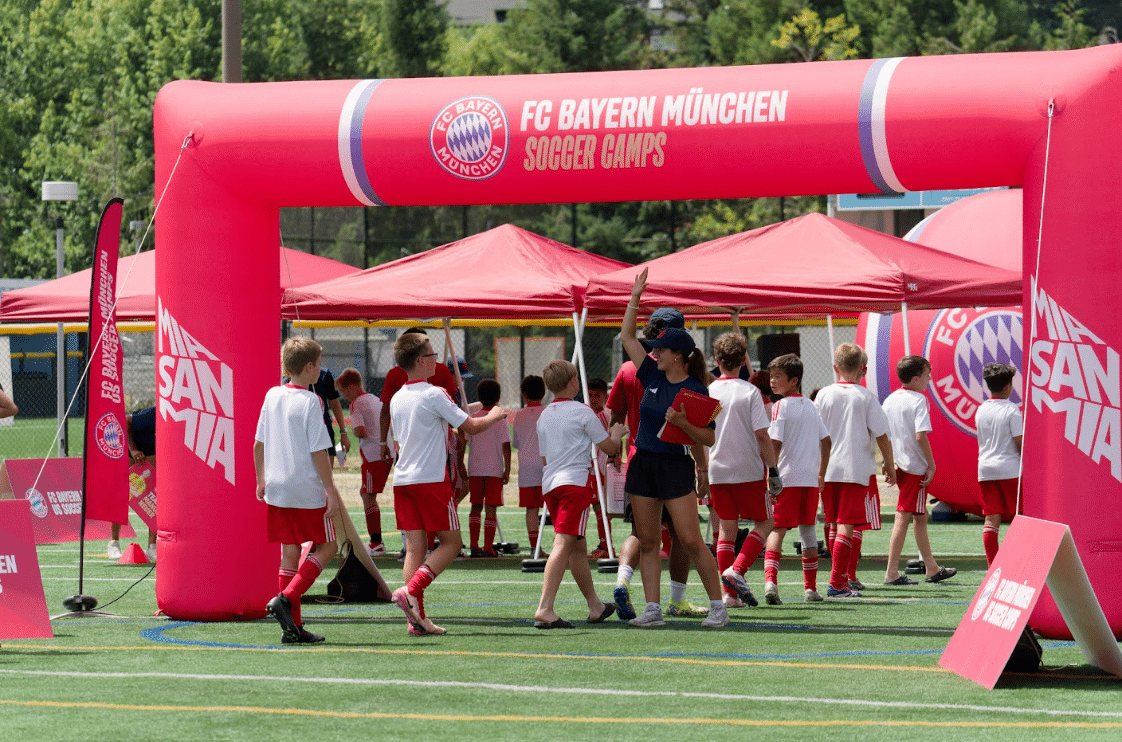
For players who aren’t ready for a residential academy, FC Bayern Soccer Camps across the US offer the first step: weekly sessions led by official FC Bayern coaches in cities across the country. From there, the FC Bayern Pathway connects camp participants to the Academy, the FC Bayern Youth Cup, the FC Bayern Global Academy, and ultimately the FC Bayern World Squad — the same structured progression used to move talent through the club’s system in Germany.
Getting there starts with the fundamentals. Players and families looking to understand what shapes that progression can start with how a qualified soccer trainer shapes player development, or with how to set effective training goals that track real progress season over season.
Frequently Asked Questions
What is European soccer training?
European soccer training is the set of academy structures and coaching methods used by Europe’s top footballing nations, from Spain’s positional play to Germany’s licensed academy network, to develop players from childhood through professional debut.
Which country has the best youth soccer academies?
No single country holds every top academy. Spain’s La Masia leads CIES Football Observatory rankings for Europe’s top five leagues, Portugal’s Benfica topped the global academy productivity index in 2025, and Germany’s licensed system produces the most consistent volume of graduates overall.
What makes La Masia different from other academies?
La Masia standardizes formation, positioning, and possession-based play from the youngest age groups, so players move through every level without relearning a new system — a model built around what’s known as the “three Ps”: possession, position, and pressing.
How does Germany’s academy system work?
Germany requires every Bundesliga and 2. Bundesliga club to operate a licensed youth academy to hold its professional license. Roughly 45 licensed centers of excellence combine full-time coaching, scouting, and academic support, with FC Bayern Campus in Munich as one example.
What percentage of academy players turn professional?
Fewer than 1% of players who enter a German youth academy ultimately turn professional. The leading programs are built around long-term development and structure, not around those odds alone.
Can players outside Europe access European soccer training standards?
Yes. FC Bayern brings its Munich Campus framework to the United States through FC Bayern Soccer Camps nationwide and the FC Bayern Academy, its first permanent residential youth academy in the Americas, opening in San Diego in September 2026.
What age do players typically start elite training in Europe?
Most European academies introduce structured, philosophy-driven training well before age ten, though residential programs like France’s Clairefontaine and FC Bayern Academy’s U15 & U17 groups typically admit players in their early teenage years.
Own Your Dream: Experience European Soccer Training Standards With FC Bayern
European soccer training has never been limited to one country, one club, or one continent — it’s a standard. FC Bayern Academy and FC Bayern Soccer Camps bring that same standard, methodology, and coaching to players across the United States. Find an FC Bayern Soccer Camp near you, or start an application to the FC Bayern Academy residential program in San Diego.