There’s a special moment every soccer family remembers: the day a young player stops chasing the ball in a swarm and finally understands where to be on the field. That click — that flash of recognition — is the beginning of real soccer intelligence. And it almost always starts with one thing: understanding youth soccer positions.
In this guide by FC Bayern Academy, we’ll walk through how youth soccer positions work across every format — from 4v4 mini-games to full 11v11 matches — and how you can support your child as they discover where they shine brightest. We’ll also share a quick-reference comparison table, the universal skills every position demands, and the most common questions soccer families ask about player development.
Why Youth Soccer Positions Matter for Player Development
Positions are far more than spots on a diagram. They are learning environments. Each role on the field teaches a unique set of skills: defenders develop spatial awareness and timing, midfielders build game intelligence and vision, forwards sharpen creativity and finishing, and goalkeepers master communication and courage under pressure.
When a young player rotates through different roles, they develop a complete understanding of how the game flows. According to US Youth Soccer, age-appropriate development should prioritize technical skills and decision-making over rigid tactical assignments — which is exactly why positional learning should feel like exploration, not restriction.
The earlier players experience multiple roles, the more adaptable, confident, and tactically literate they become as they grow. A child who has played as a defender understands how forwards exploit space. A midfielder who has spent time in goal reads passing lanes more clearly. Every position teaches lessons that improve performance everywhere else on the field.
How Field Size Shapes Youth Soccer Positions
Field size is the hidden architect of every soccer formation. Smaller fields mean fewer players, fewer positions, and dramatically more touches on the ball — which is exactly what young athletes need. As fields grow, so does the complexity of roles and responsibilities.
This is why small-sided games form the foundation of modern player development. The progression typically follows this path: 4v4 → 7v7 → 9v9 → 11v11. Each stage introduces new tactical concepts at exactly the right cognitive moment for the player’s age.
U.S. Soccer’s Player Development Initiatives established these standards specifically because they maximize ball involvement, decision-making opportunities, and skill repetition for kids. The format isn’t arbitrary — it’s engineered around how children actually learn.
A child playing 4v4 can touch the ball hundreds of times in a single game. That same child dropped into an 11v11 environment too early might only touch the ball a handful of times. Repetition builds mastery, and small-sided formats are designed to give every player as many of those repetitions as possible.
Quick-Reference Table: Youth Soccer Positions by Format
Use this table as a snapshot of how positions in youth soccer by age evolve as the field grows.
| Age Group | Format | Field Size (approx.) | Goalkeeper | Player Roles | Common Formations | Primary Focus |
|---|---|---|---|---|---|---|
| 6–8 | 4v4 | 25 × 35 yards | No | 2 defenders, 2 attackers (rotating) | Diamond / Rotational | Dribbling, ball mastery, fun |
| 9–10 | 7v7 | 47 × 30 yards | Yes | 1 GK, 2 DEF, 3 MID, 1 FWD | 2-3-1 / 2-2-2 | Width & depth, basic teamwork |
| 11–12 | 9v9 | 70 × 45 yards | Yes | 1 GK, 3 DEF, 3 MID, 2 FWD | 3-3-2 / 3-2-3 | Transitions, positional rotation |
| 13+ | 11v11 | 110 × 70 yards | Yes | 1 GK, 4 DEF, 3–4 MID, 2–3 FWD | 4-3-3 / 4-4-2 / 4-2-3-1 | Positional play, tactical mastery |
This progression mirrors how children grow physically, cognitively, and emotionally. Each stage adds just the right amount of complexity — never overwhelming, always engaging.
Youth Soccer Positions by Age and Format
Now let’s break down exactly how positions in youth soccer by age unfold across each format.
Ages 6–8 — 4v4 Format (No Goalkeeper)
At this stage, the focus is fun, freedom, and first touches. With only four players per side and no goalkeeper, every child is constantly involved.
Typical roles include 2 defenders and 2 attackers, often arranged in a rotating diamond shape that encourages movement in all directions. The priorities here are simple: dribbling, ball mastery, and developing a love for the game. Coaches encourage players to attack, defend, and switch roles freely — there are no rigid assignments yet.
This is also the age where creativity matters more than structure. A 7-year-old who tries an audacious move and loses the ball is learning more than one who plays it safe. Mistakes are the curriculum.
Ages 9–10 — 7v7 Format (With Goalkeeper)
The 7v7 stage introduces the goalkeeper and begins shaping recognizable soccer positions for kids. A standard lineup includes a GK, 2 defenders, 3 midfielders, and 1 forward, often in a 2-3-1 or 2-2-2 formation.
This is where players first encounter the concepts of width (using the full field side-to-side) and depth (creating space front-to-back). They start to recognize when to support a teammate, when to spread out, and how positioning shapes opportunity.
It’s also the first time most young players experience real positional discipline — staying connected to teammates rather than chasing the ball. That single shift in mindset is one of the biggest leaps in early development.
Ages 11–12 — 9v9 Format
The 9v9 format is a critical bridge to the full game. Teams typically field a GK, 3 defenders, 3 midfielders, and 2 forwards in formations like 3-3-2 or 3-2-3.
At this age, players are introduced to positional rotations and transitions — moving fluidly between attack and defense as a unit. Decision-making becomes more sophisticated, and field player roles start to feel real and meaningful.
Players begin to specialize in zones (left, right, central) and develop preferences. A natural left-footer may flourish on the left flank; a creative passer may thrive in central midfield. Coaches start identifying tendencies — but smart programs continue rotating players to keep development broad.
Ages 13+ — 11v11 Format (Full Field)
The full 11v11 game brings the complete tactical picture into view. A standard lineup features a GK, 4 defenders, 3–4 midfielders, and 2–3 forwards, with popular formations including 4-3-3, 4-4-2, and 4-2-3-1.
This is where elite youth soccer formations meet real tactical execution. The FC Bayern methodology emphasizes positional play and technical mastery at this stage — teaching players not just where to stand, but how to read the game, manipulate space, and impact every phase of play.
By this age, young athletes are ready to absorb advanced concepts like pressing triggers, switching the point of attack, and creating numerical superiority. The game becomes a chess match — and the best players learn to think two moves ahead.
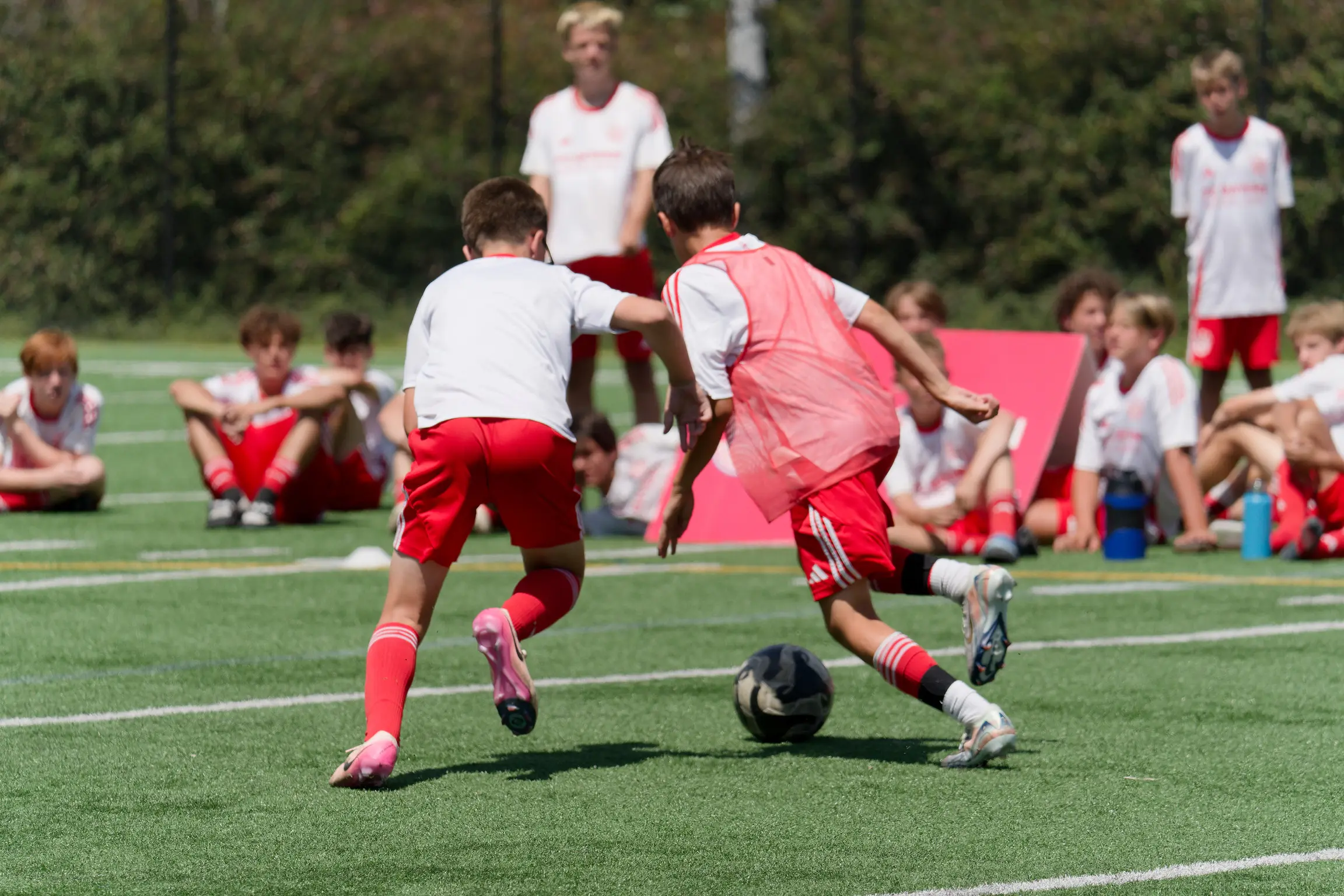
The Main Player Roles in Youth Soccer Explained
Understanding the broader picture of youth soccer positions means knowing what each role demands.
The goalkeeper is both the team’s last line of defense and its first attacker. Beyond shot-stopping, modern goalkeepers organize the back line, distribute with precision, and start attacking sequences with their feet. The position rewards courage, communication, and quick decision-making.
Defenders include center backs, who anchor the back line with physical presence and reading of the game, and fullbacks, who balance defensive duties with overlapping runs to support the attack. Great defenders are calm under pressure, strong in 1v1 duels, and confident in possession.
Midfielders are the engine room. Defensive midfielders shield the back line, central midfielders dictate tempo and connect lines, and attacking midfielders create chances in the final third with vision and creativity. The position demands stamina, intelligence, and a constant scanning habit.
Forwards include wingers, who use speed and dribbling on the flanks, and strikers, who specialize in finishing and movement inside the box. The best forwards combine technique with relentless work rate — pressing defenders and creating chaos when they don’t have the ball.
How to Help Your Child Find the Right Position
The healthiest approach to player development is rooted in versatility. In the early years, encourage your child to play multiple roles. Rotation builds well-rounded athletes and prevents the limitations of early specialization.
Research compiled by the Aspen Institute Project Play consistently shows that young athletes who specialize too early face higher risks of burnout, injury, and dropout. Variety isn’t just safer — it’s smarter.
Listen to what your child enjoys. Some kids feel electric on the wing; others love the chaos of central midfield or the responsibility of defending. The grown-ups on the sideline play their best role by observing, encouraging, and celebrating effort — not by assigning a position too soon.
The world’s best clubs build complete players first. Specialization comes later, and only after a strong foundation of skill and game understanding is in place. A 10-year-old who insists they’re “only a striker” often becomes a more limited 16-year-old. The young athletes who thrive long-term are the ones who can play three positions well before they choose one to master.
Building Skills That Translate Across Every Position
No matter which player roles in youth soccer your child eventually gravitates toward, certain skills are universal. Every elite academy in the world prioritizes them.
First touch allows a player to control the ball under pressure. Scanning — the habit of constantly looking around before receiving — gives players time and options. 1v1 ability, in both attack and defense, separates good players from great ones. Passing accuracy under different conditions is the language of team play. And off-ball movement — running smartly even when you don’t have the ball — is what unlocks space for teammates.
These fundamentals are trained universally because they apply universally. A goalkeeper, a striker, and a fullback all need them — just in different proportions. The best youth programs build these skills into every training session, whether the focus is technical, tactical, or physical.
Frequently Asked Questions About Youth Soccer Positions
At what age should a child start specializing in one position?
Most player development experts recommend waiting until at least ages 13–14 before specializing. Before then, exposure to multiple roles builds tactical intelligence, prevents burnout, and creates more versatile athletes long-term.
What’s the best position for a beginner?
There’s no single “best” position. The healthiest approach is rotation — letting young players try defender, midfielder, forward, and even goalkeeper. They’ll naturally gravitate toward roles that match their personality, instincts, and physical traits.
How do I know if my child is in the right position?
Watch for engagement and confidence. A child in the right role plays with energy, makes decisions decisively, and looks like they’re enjoying themselves. If they look lost, hesitant, or disengaged, a different position might be a better fit.
Should small kids play goalkeeper?
Yes — but in rotation, not exclusively. Time in goal teaches distribution, communication, and bravery. However, no child under 12 should be locked into the position permanently; well-rounded development matters more.
Take the Next Step at the FC Bayern Youth Summer Camp
If your child is ready to experience youth soccer positions in a world-class environment, the FC Bayern Youth Summer Camp is the perfect next step. Built around the legendary FC Bayern methodology, the camp combines certified coaches, age-appropriate training, and game-realistic scenarios that bring every position to life.
Young players will sharpen their technique, deepen their tactical understanding, and discover where they truly shine on the field. More than a training program, it’s a once-in-a-lifetime experience that connects kids with the values, intensity, and joy of one of the world’s most respected clubs.
Reserve Your Spot at the FC Bayern Youth Summer Camp
Give your child the field, the coaching, and the moment they’ll never forget.